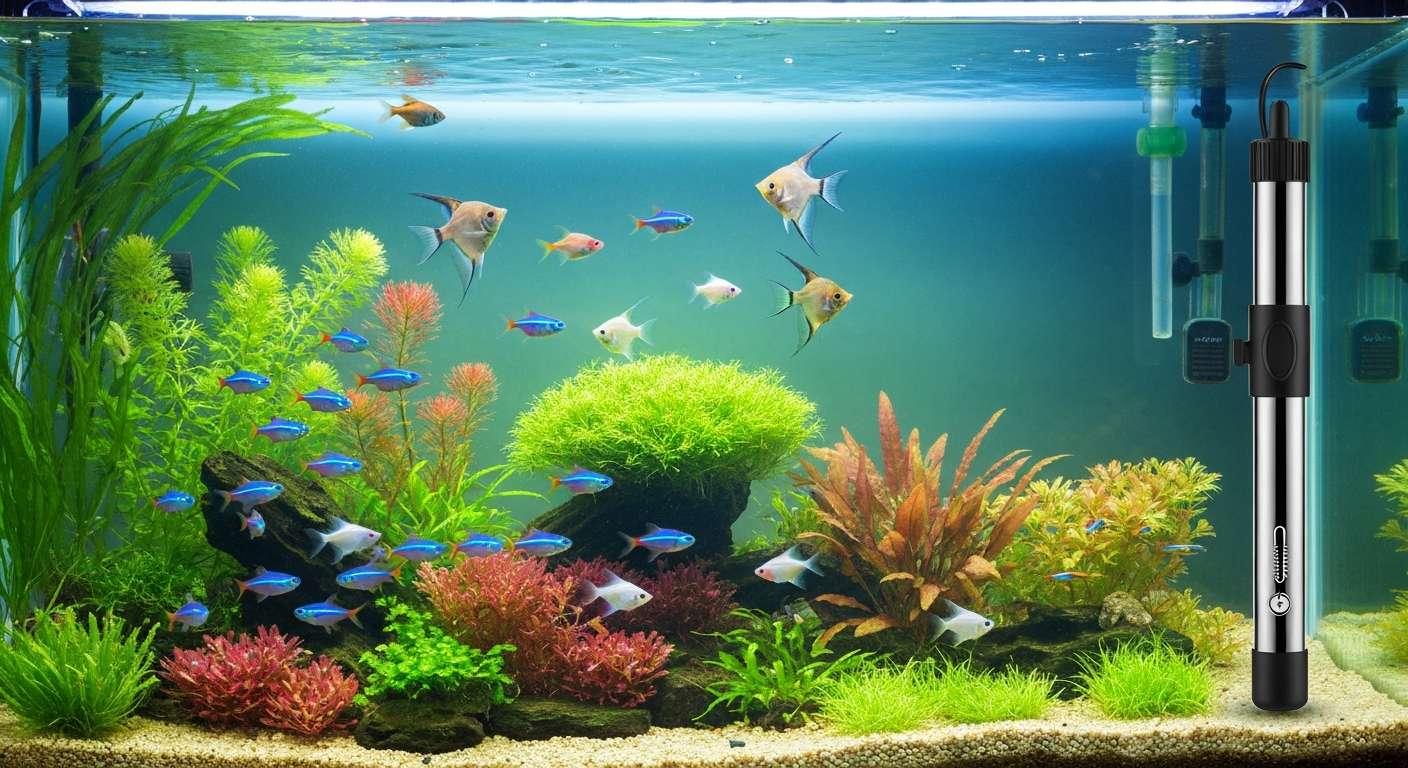
Temperature stability is one of the most important factors in fish health. Tropical fish kept too cold become lethargic and immunocompromised. Sudden temperature swings stress fish and trigger disease outbreaks. A reliable aquarium heater, properly sized and installed, is the foundation of a stable tank environment — and often the difference between a thriving tank and a struggling one.
This guide covers how to size a heater correctly, the differences between heater types, and which brands are worth the money.
How to Size a Heater: Wattage Guide
The most common mistake when buying a heater is under-sizing. A heater that has to run constantly at maximum effort to maintain temperature will fail prematurely and may still lose the temperature battle in a cool room.
The standard rule is 3–5 watts per gallon, but the right number depends on how much warmer your tank needs to be than your ambient room temperature:
- If your room stays 68°F+ and your target is 76–78°F: 3 watts/gallon is sufficient
- If your room is 65°F or below, or your target is 80°F+: 5 watts/gallon
Practical sizing guide:
- 10-gallon tank: 50–100 watts
- 20-gallon tank: 100–150 watts
- 29–40 gallon tank: 150–200 watts
- 55–75 gallon tank: 200–300 watts
- 90–125 gallon tank: 300–500 watts (consider two heaters)
- 150+ gallon tank: Two heaters totaling 500–750 watts
For tanks over 75 gallons, use two heaters instead of one large one. Two 150-watt heaters in a 125-gallon tank provide redundancy — if one fails, the other keeps the tank warm until you notice and replace it. A single heater failure in a large tank can crash the temperature before you realize it.
Always Use a Separate Thermometer
Every aquarium heater with a built-in thermostat should be verified with an independent thermometer. Built-in thermostat accuracy varies significantly between brands and individual units — a heater set to 78°F may actually be holding 74°F or 82°F.
A simple glass immersion thermometer (a few dollars at any fish store) or a digital thermometer probe is essential. Check it when you first set up the heater and recalibrate your heater's dial if needed.
Heater Types
Submersible Heaters (Most Common)
Fully submersible heaters attach to the inside of your tank via suction cups, typically near the filter output for even heat distribution. They're the most widely available and suitable for most setups. For best accuracy, position the heater horizontally near the bottom of the tank rather than vertically — this ensures more even heating along the length of the element.
Hang-On-Back Heaters
An older style where only the heating element is submerged; the thermostat hangs above the waterline. Less common now and generally less accurate than fully submersible models. Avoid if possible.
Inline Heaters
Installed in the return line of a canister filter, heating water as it flows through. Excellent for tanks where you want no visible equipment inside. More expensive and requires a canister filter with appropriate tubing diameter. Popular in planted tanks and high-end reef displays. Brands: Hydor Inline, Cobalt Aquatics Inline.
Titanium Heaters with External Controllers
The most precise and reliable option. A titanium heating element (inert, unbreakable) pairs with an external temperature controller that reads from a probe in the tank. The controller switches the heater on/off to maintain exact temperature within ±0.1°F. Expensive but worth it for discus tanks, breeding setups, and any situation where precision matters. Brands: Inkbird ITC-306A, Ranco ETC-211000, Aquarium Co-Op USB Heater with Inkbird controller.
Top Heater Brands
Eheim Jager (Best Overall)
Made in Germany, the Jager line has a decades-long reputation for thermostat accuracy and durability. Fully submersible, shatterproof glass, recalibration dial on the top. The 150W and 200W models are particularly reliable. More expensive than budget options but substantially more accurate. Available at most quality local fish stores.
Aqueon Pro
Shatterproof construction with an auto-shutoff if it's removed from water while on — prevents the element from burning out. LED indicator changes color to show whether the heater is heating or at temperature. Good value, widely available, reliable. A solid choice for 20–55 gallon tanks.
Fluval E-Series
Digital display on the heater shows actual water temperature and set temperature simultaneously. Dual temperature sensors for accuracy. The display makes it easy to verify temperature at a glance without a separate thermometer. Excellent mid-range option.
Cobalt Aquatics Neo-Therm
Ultra-flat design that takes up minimal space. Electronic thermostat with ±0.5°F accuracy — one of the most precise non-titanium heaters available. LED display on the unit. Popular in planted tanks where aesthetics matter.
Heaters to Avoid
Generic unbranded heaters from marketplace sellers have inconsistent quality control. A $10 heater that fails open (stays on continuously) will cook your fish. A heater that fails closed (stays off) will slowly chill them. Buy from a recognized brand, available at your local fish store where you can return it if there's an issue.
Installation Tips
- Wait 30 minutes after placing a new heater in the tank before plugging it in — the glass needs to equilibrate to the water temperature
- Position near flow — place the heater near the filter output or powerhead to distribute warm water evenly
- Don't let it run dry — always unplug the heater before doing water changes that would expose the element to air
- Check the cord position — create a drip loop in the power cord so condensation doesn't run along the cord to the outlet
- Replace every 2–3 years — even reliable heaters degrade over time; the thermostat accuracy drifts and the element weakens
Where to Buy
Aquarium heaters are available at your local fish store, where staff can advise on the right wattage for your specific tank and situation. Buying locally also means you can return or exchange a faulty unit easily. Find a quality fish store near you using LFS Directory.