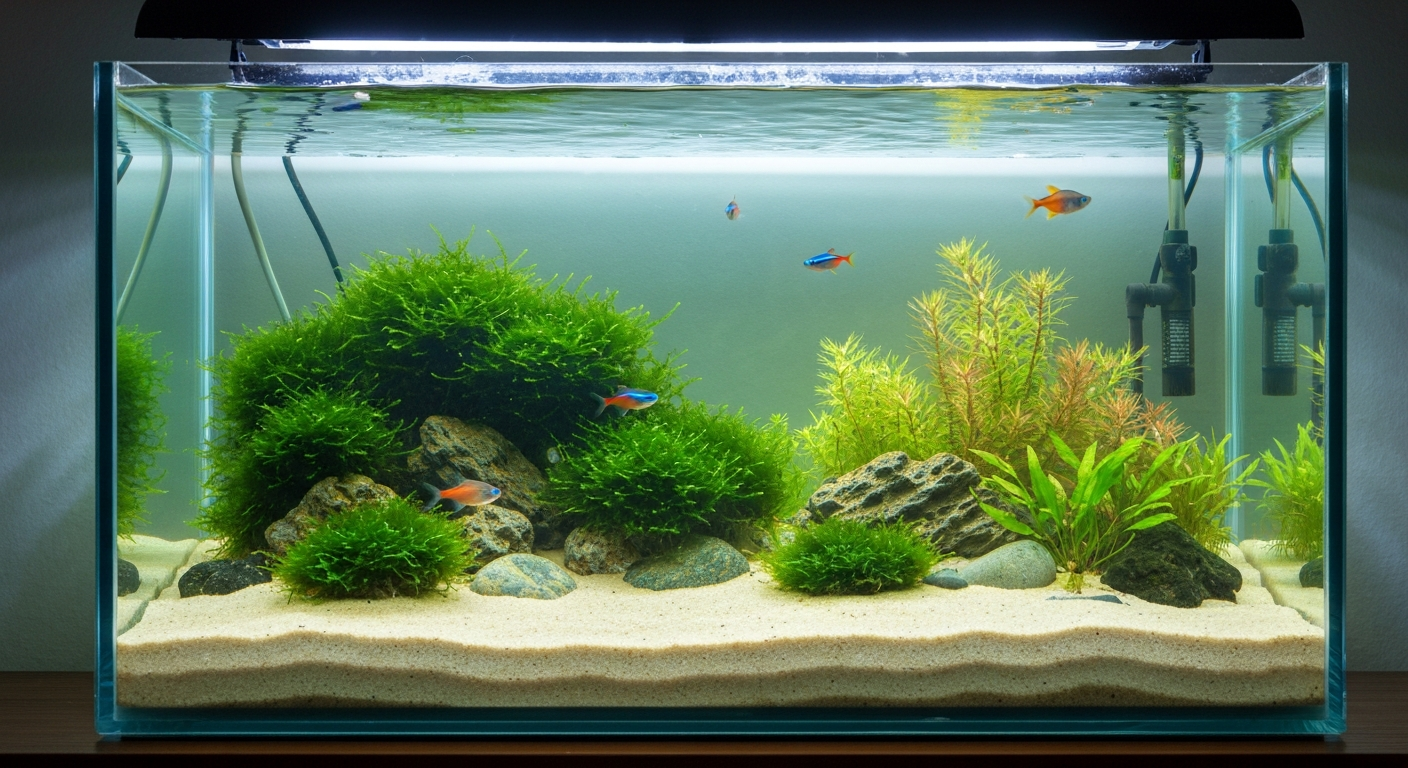
Choosing Your First Tank
The single most common beginner mistake is starting too small. A 20-gallon tank is the ideal minimum for a first freshwater setup — it is large enough to maintain stable water parameters, small enough to fit on a standard piece of furniture, and affordable enough that the total investment stays reasonable. Avoid tanks smaller than 10 gallons for your first setup; smaller volumes are actually harder to maintain because temperature, pH, and ammonia levels fluctuate more rapidly. A standard 20-gallon long tank gives you the best footprint for fish swimming space and aquascaping flexibility.
Buy the tank, stand, and lid together if possible. A proper aquarium stand is important — water weighs about 8.3 pounds per gallon, so a filled 20-gallon tank with substrate and equipment weighs close to 200 pounds. Furniture that was not designed for this load can fail catastrophically.
Essential Equipment
You need five pieces of equipment to run a healthy freshwater tank. Do not skip any of them.
- Filter: A hang-on-back (HOB) filter rated for your tank size is the simplest and most reliable choice for beginners. Look for one rated for 20–30 gallons even if your tank is 20 gallons — slight over-filtration is always better than under-filtration. The filter is where your beneficial bacteria live, so it is the most important piece of equipment you will buy. Read our water test kit guide to understand why water quality monitoring matters.
- Heater: Most tropical freshwater fish need water between 76°F and 80°F. A submersible heater with a built-in thermostat is the standard choice — budget about 5 watts per gallon (so a 100-watt heater for a 20-gallon tank). Check out our heater selection guide for detailed recommendations.
- Thermometer: Do not rely solely on your heater's thermostat. A simple glass or digital thermometer lets you verify the actual water temperature daily. This costs a few dollars and prevents disasters.
- Lighting: A basic LED light on a timer (8–10 hours per day) is sufficient for a fish-only setup. If you plan to grow live plants, invest in a light rated for planted tanks — the difference in plant health is dramatic.
- Substrate: Gravel or sand, 1.5 to 2 inches deep. For a fish-only tank, standard aquarium gravel works fine. If you want live plants, consider a nutrient-rich planted tank substrate — it is more expensive upfront but eliminates the need for root fertilizers later.
The Nitrogen Cycle: Why Patience Matters
This is the most important concept in fishkeeping, and the one that trips up the most beginners. When fish produce waste, it breaks down into ammonia — which is toxic. Beneficial bacteria convert ammonia to nitrite (also toxic), and then other bacteria convert nitrite to nitrate (much less toxic, removed by water changes). This process is called the nitrogen cycle, and your tank needs to establish these bacterial colonies before it can safely support fish.
Cycling your tank takes 4 to 6 weeks. Set up your tank with all equipment running, add a source of ammonia (pure ammonia drops, a piece of raw shrimp, or a bacterial starter product), and test the water every 2–3 days with a liquid test kit. You will see ammonia spike, then nitrite spike, then both drop to zero as nitrate rises. When ammonia and nitrite both read zero and nitrate is present, your tank is cycled and ready for fish.
Do not skip this step. Adding fish to an uncycled tank is the number one cause of fish death in new setups. Your local fish store can help you monitor your cycle — many will test your water for free if you bring in a sample.
Stocking Your First Tank
Start slow. Add 3–5 small fish after your cycle is complete, wait two weeks, test your water, and then add more if parameters are stable. For a 20-gallon tank, good beginner species include:
- Corydoras catfish (group of 6) — peaceful bottom-dwellers that help clean uneaten food
- Neon or cardinal tetras (school of 8–10) — colorful, active, and hardy once the tank is cycled
- Honey gouramis (1–2) — peaceful centerpiece fish with great personality
- Cherry barbs (group of 6) — hardy, colorful, and active at all tank levels
- Nerite snails (2–3) — excellent algae control with no risk of overpopulation
Avoid common impulse purchases that will outgrow your tank: common plecos (they reach 18+ inches), oscars, red-tailed catfish, and most sharks. Research every fish before buying — your acclimation process matters just as much as your species choice. Visit your local fish store and ask staff what they recommend for your specific setup.
Maintenance Schedule
A healthy freshwater tank requires consistent, simple maintenance. Here is what a realistic schedule looks like:
- Daily: Check temperature, observe fish behavior, feed once or twice (only what fish consume in 2 minutes)
- Weekly: 20–25% water change using a gravel vacuum, top off evaporation, clean glass if needed
- Monthly: Rinse filter media in old tank water (never tap water — chlorine kills beneficial bacteria), trim plants, check equipment
- As needed: Test water parameters with a liquid test kit — especially after adding new fish or if behavior changes
Water changes are non-negotiable. They remove nitrate, replenish minerals, and keep your fish healthy long-term. Use a water conditioner (dechlorinator) every time you add tap water to the tank.
Common Mistakes to Avoid
- Overfeeding: This is the most common cause of water quality problems. Fish need far less food than most beginners think. Feed small amounts and remove any uneaten food after 2 minutes.
- Overstocking: More fish means more waste, which means faster water quality decline. Follow the general rule of 1 inch of adult fish per 2 gallons as a rough starting guideline, then research each species' actual space needs.
- Replacing all filter media at once: Your filter media houses your beneficial bacteria. Replacing it all at once crashes your cycle. Only replace media when it is physically falling apart, and do it one piece at a time with weeks between replacements.
- Chasing pH: Unless you are keeping species with very specific pH requirements, a stable pH is more important than a perfect number. Most common freshwater fish adapt to a wide range of pH. Constant chemical adjustments cause more stress than slightly imperfect water.
- Skipping quarantine: New fish should ideally be quarantined in a separate tank for 2–4 weeks before adding them to your display. This prevents introducing disease to your established fish. If you cannot quarantine, at minimum buy from a store that quarantines their own stock.
The best resource you have is your local fish store. Find a shop near you using our store directory, build a relationship with the staff, and do not be afraid to ask questions — experienced hobbyists love helping beginners succeed.